
When running complex projects across an entire country – spanning roads, earthworks, utilities (VRD), civil engineering, and environmental works – the primary challenge isn’t simply “doing tech.” The real challenge is maintaining control.
In large-scale operations, when projects multiply, crews rotate, and subcontractors change, margins are not lost in single catastrophic events. They are eroded by small, daily deviations. This reality applies to any large organization operating under tight margins, heavy contracts, and complex logistics.
The difference between profitable execution and a month-end crisis often comes down to the speed of information.
The Core Problem: The Fragmented Truth
Most enterprise groups already possess an abundance of tools. The issue is rarely a lack of data; it is that the “truth” is fragmented.
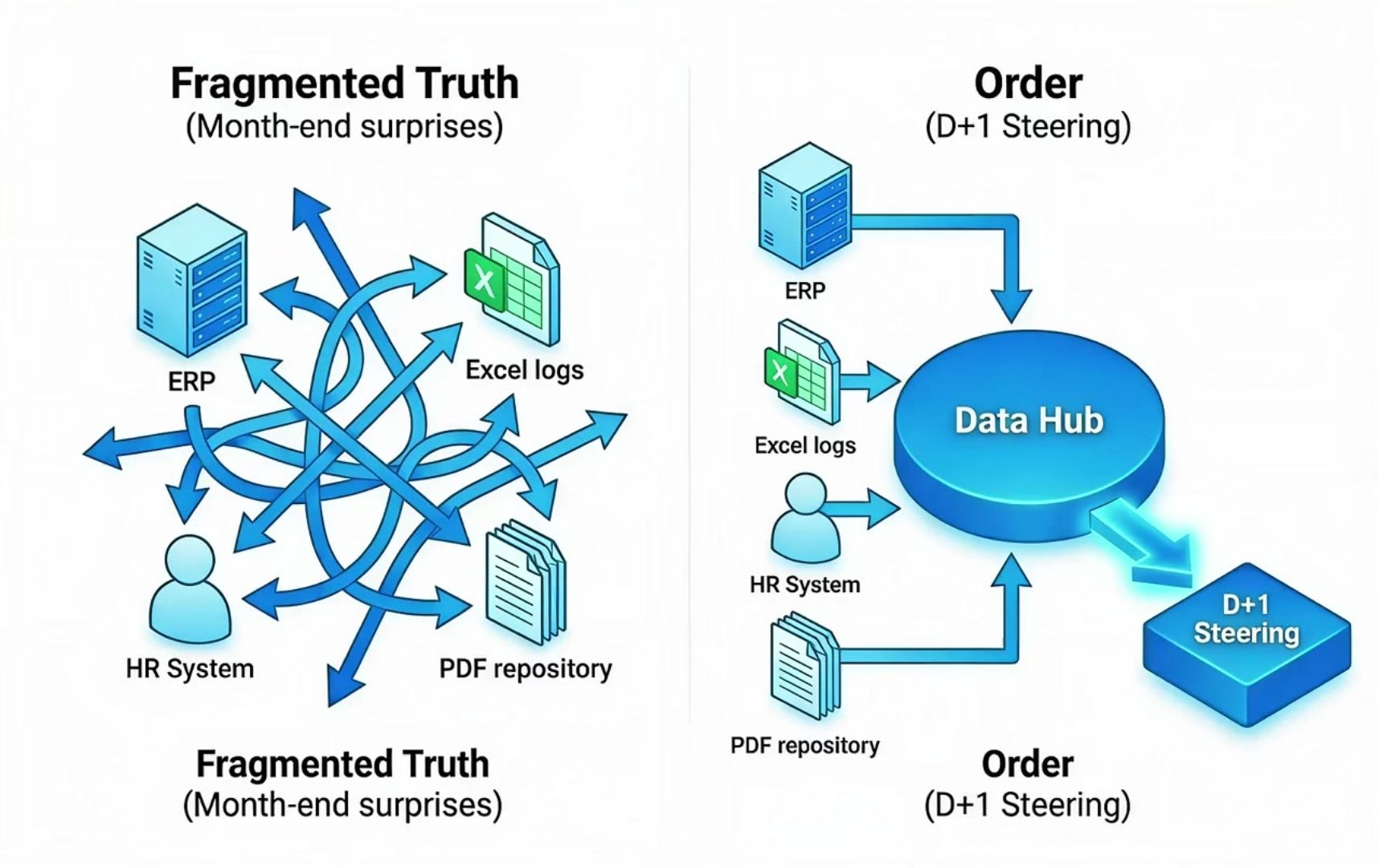
Critical operational data lives isolated in site logs, ERPs, various planning tools, equipment telemetry systems, procurement software, HR databases, and HSE document repositories. Each system tells part of the story, but none tell the full story fast enough. This results in “month-end surprises,” where leadership only gets visibility when it is too late to course-correct.
For a CTO or Operations leader, the defining question isn’t, “How do we build a platform?” It is: How do we give the business a next-day, auditable truth – and turn it into decisions that protect margin and reduce risk?
Two strategic moves consistently create value at scale to address this:
- Implementing a governance-grade Data Hub to steer operations on a D+1 (next-day) basis.
- Deploying Document & Legal AI to eliminate silent contractual risk.
Move 1: The Data Hub – Steering vs. Reporting
A Data Hub is not merely a “data project.” It is an operating model designed to produce a shared, auditable truth across trades, entities, and projects.
Many data initiatives fail because they deliver passive visibility rather than active steering capabilities. A successful Hub must answer one vital question every morning: Where are we drifting, and what needs action today?
The North Star: D+1 Margin & Risk
To achieve this, leadership must abandon complex dashboards and data lakes in favor of a simple, daily steering view anchored on three essential numbers per project:
- Cost-to-complete (EAC) vs. budget.
- Progress reality (physical progress vs. planned).
- Risk signals (schedule slippage, subcontracting spikes, equipment anomalies, contractual exposure).
Why “D+1 Truth” Matters
Operations are filled with decisions that cannot wait until month-end reconciliation. You are dealing with subcontractor productivity issues, equipment idle time, unplanned rework, and schedule slippages that trigger cascading effects.
When truth arrives late, you manage consequences. When truth arrives the next day (D+1), you manage causes.
The 80/20 Model: A System of Record for Decisions
Forget the paralyzing goal of “integrating everything.” Start with a model that matches how the business actually thinks. By aligning six key dimensions – Project/Site, Cost, Resources, Plan, Events, and Sustainability – you build a “system of record for decisions.”
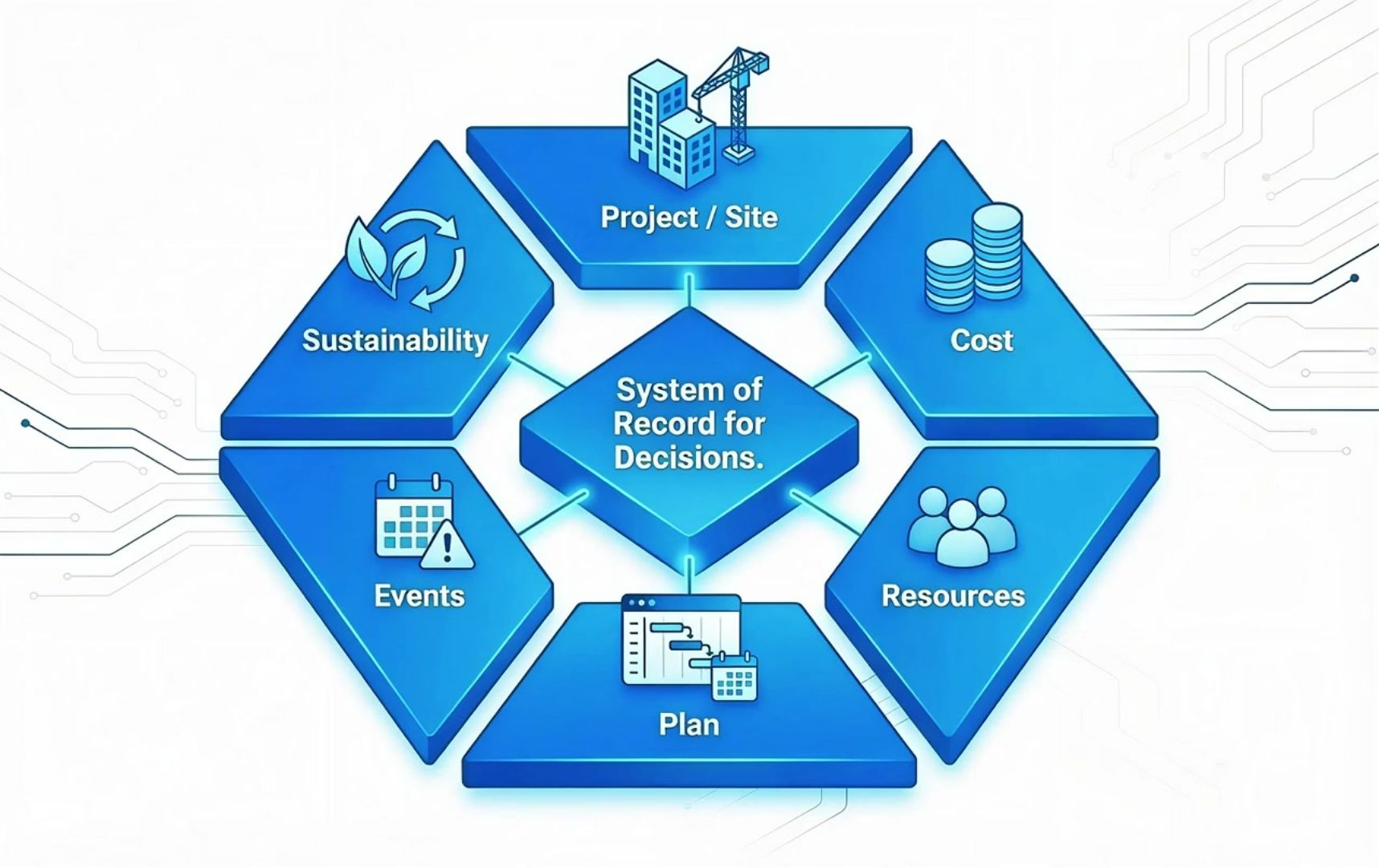
If you can align these dimensions effectively, a CTO should be able to answer five critical questions every morning without manual consolidation:
- Which projects are drifting on margin – and what’s driving it?
- Which projects are at risk in the next 2–3 weeks?
- Where is equipment performance abnormal?
- Where is subcontracting becoming a margin leak?
- Where are we exposed to penalties or contractual milestones?
The Governance That Makes It Work
If “margin” means something different across various business entities, nobody will trust the Hub. If nobody trusts it, nobody will steer with it. Three non-negotiables are required:
- One common glossary for key concepts (e.g., defining “margin,” “progress,” and “done”).
- Data Products by domain (Ops, Finance, Plant, etc.) assigned to a specific business owner.
- A defined service level for data freshness and quality.
Move 2: Document & Legal AI – Reducing Silent Risk
In large operational groups, contractual risk is rarely due to a lack of legal competence. It is a scale problem. There are simply too many documents, too many versions, and too many change orders for human teams to monitor continuously.
This creates a “Silent Risk” radar, where thousands of dollars in potential exposure remain hidden in PDFs.
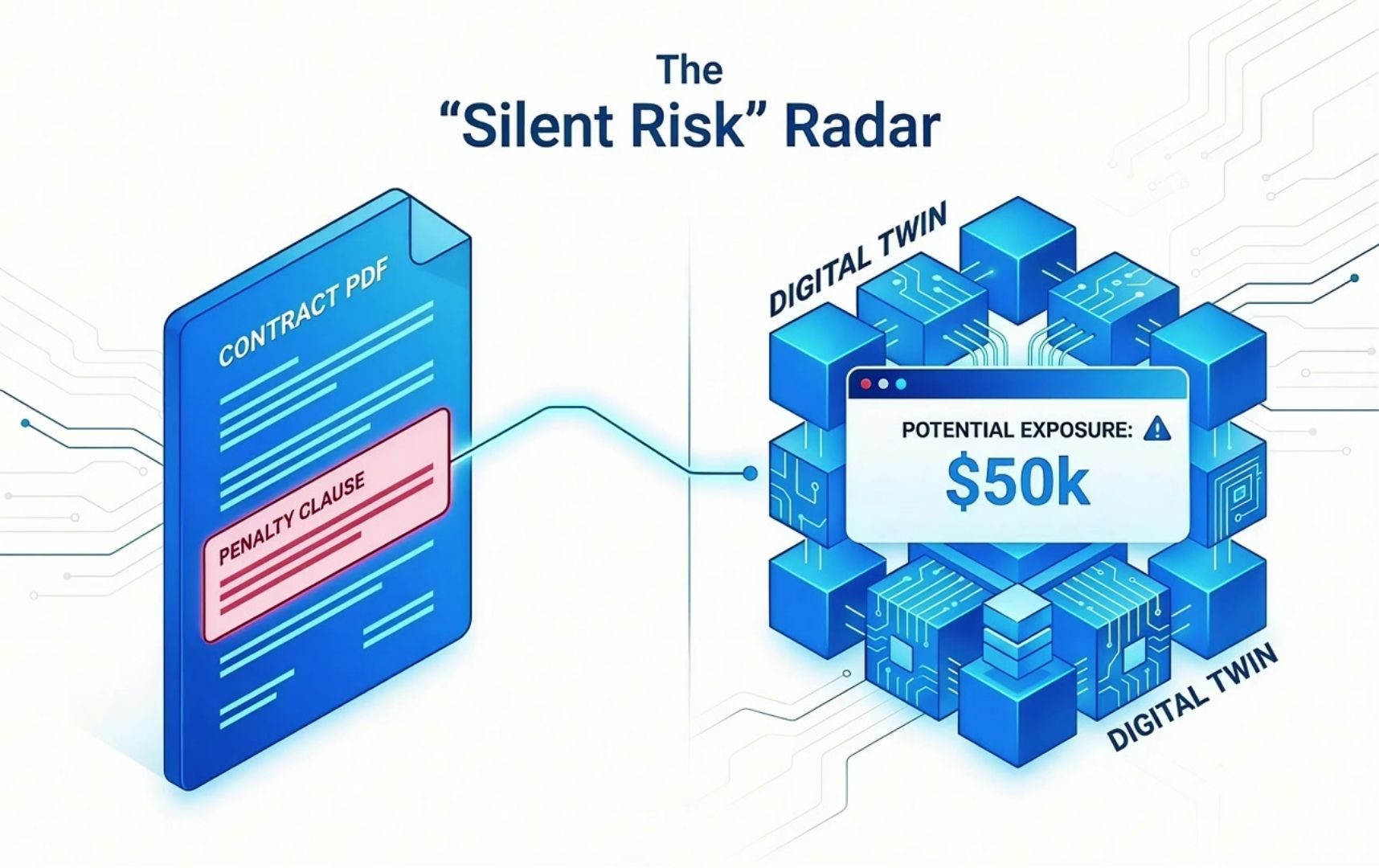
Legal AI is not about replacing lawyers; it is about ensuring no critical clause remains hidden. The goal is to deploy a “digital twin” of your contract portfolio to identify exposure.
What to Automate First (MVP)
Start with the extraction of and alerting on key risk factors:
- Penalties (rates, caps, triggers).
- Deadlines and milestones.
- Guarantees, bonds, and retention clauses.
- Price revision clauses.
- Termination/suspension conditions.
The ultimate goal is to deliver a “Killer Feature”: a one-page standard contract summary, alongside version comparisons for change orders.
Enterprise Guardrails
To be accepted at scale, AI integration must have rigid guardrails:
- Human validation: AI suggests; legal/contract managers validate.
- Audit logs: Tracking who validated what, when, and on which version.
- Role-based access: Strict controls for sensitive content.
Compounding Value: The Synergy
The real magic happens when you connect Document AI to the Data Hub. Suddenly, you can see milestone risk sitting right next to schedule risk. You see penalty exposure next to margin drift. This is when legal transitions from “paperwork” to a live risk-control function.
The Execution Roadmap
For groups that build infrastructure, the goal isn’t to chase technology trends. It is to protect what matters: independence, performance, and responsibility. The point isn’t digitalization; the point is avoiding surprises.
If you are trying to achieve D+1 steering without “ripping and replacing” existing infrastructure, here is a practical roadmap.
0–30 Days: Align and Prove
- Agree on 10 key metrics (margin, progress, cost-to-complete).
- Define minimum identifiers across systems.
- Run a legal AI pilot on real, historical contracts.
30–90 Days: Deliver Steering
- Build the D+1 Margin & Risk pilot (one entity + a handful of projects).
- Deploy 4–6 high-value alerts (fuel anomalies, idle equipment, subcontracting spikes).
- Put legal AI in limited production (summaries + alerts).
- Establish a weekly “Run to Margin” ritual with Ops and Finance.
90–180 Days: Industrialize
- Expand the model across further entities.
- Add robust data quality monitoring.
- Connect equipment telemetry and sustainability metrics.
- Strengthen legal AI with version differencing and enterprise search capabilities.
Ready to move from month-end surprises to real D+1 steering?
Book a working session with the ITSharkz team.