
The raid on X’s Paris offices wasn’t just political theater. It was a signal.
When the French government ordered ministries to swap Zoom for Vizio and blocked the sale of Eutelsat to private equity, the message was clear: Digital Sovereignty is no longer a “nice-to-have” for EU companies. It is a survival strategy.
For years, we’ve operated under the “Short-Term Software Trap.” We built our architectures on the path of least resistance, relying on US hyperscalers and off-the-shelf tools because they were fast and cheap.
But the bill for that convenience is coming due.
Currently, Europe relies on non-EU countries for over 80% of its digital infrastructure. For a scale-up, this is a massive strategic vulnerability. Unlike physical goods, digital services are ongoing relationships. If a provider in Silicon Valley changes their algorithm, pricing model, or access terms, your market access changes instantly, without negotiation.
The question for European CTOs is no longer “How fast can we build?” It is: “Who actually owns the foundation we are building on?”
The High Cost of “Renting” Your Future
Reliance on non-EU tech giants creates three specific risks for European scale-ups:
- Regulatory Fragility: With GDPR/RODO enforcement tightening, hosting critical data on US-controlled clouds invites scrutiny.
- Vendor Lock-in: The “Hotel California” effect-easy to check in, impossible to migrate away without rebuilding your entire stack.
- Innovation Lag: The EU currently invests only 7% of global R&D in software, compared to 71% by the US. Relying solely on imported innovation leaves you one step behind.
The Solution: The “Sovereign Stack” Strategy
Total decoupling is impossible (and unwise). The smart move is De-risking. Leading innovators are now building “Sovereign Stacks”, modular architectures where the core IP, data layer, and critical logic are owned, operated, and hosted within the EU regulatory framework.
This requires a shift in how we think about engineering teams. You can’t build a sovereign product with a team that views compliance as an afterthought.
Why Poland is the Engine Room of Sovereignty
This is where the “Talent Bottleneck” meets the “Sovereign Solution.” Poland has quietly become the hub for this transition. Why? Because Polish engineers don’t just write code; they operate within the same EU legal and cultural framework as your headquarters in Paris or Berlin.
At ITSharkz, we see this daily. Our partners aren’t just looking for “coders.” They are looking for:
- Security by Design: Teams that understand GDPR/RODO intuitively, not as a checklist.
- Fiscal Efficiency: For our French partners, working with EU-based teams unlocks CIR/CII R&D tax credits, effectively subsidizing the cost of innovation.
- Stability: In a volatile market, our 0% rotation culture means the knowledge stays in your stack, not out the door.
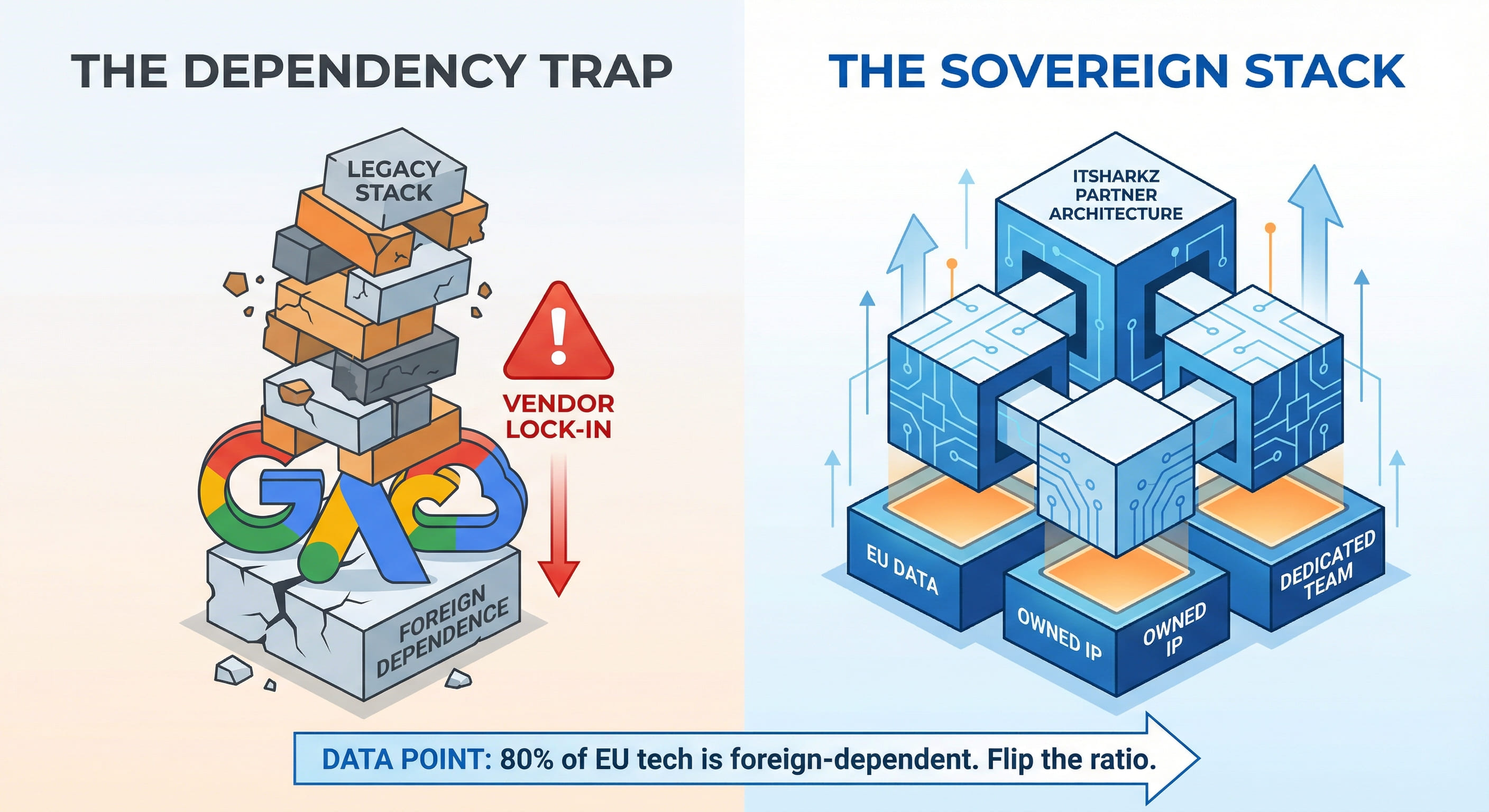
The shift to sovereign tech isn’t about patriotism; it’s about control. If your codebase is dependent on a platform you can’t control, you don’t own a product. You own a liability.
The companies that win the next decade will be the ones that own their intellectual property and their infrastructure.
Code can be rewritten. Lost sovereignty cannot.
Is your current tech stack an asset, or a liability waiting to happen? Let’s discuss how to future-proof your roadmap and build a dedicated engineering team that secures your IP within Europe.