

B2B companies lose contracts to slow proposal processes far more often than their CRM records show. The system gets a note saying “client chose another offer” – but the real reason is often different: the response arrived too late.
According to Loopio’s 2025 RFP Trends & Benchmarks Report, 68% of proposal teams used generative AI in their RFP response process over the past year – roughly twice as many as the previous year. Companies that haven’t automated aren’t standing still. They’re losing ground.
This article answers the questions sales directors and business owners ask before making a decision: what exactly does an AI agent automate in the proposal process, how much time and money does it save, when does the investment make sense – and when it doesn’t.
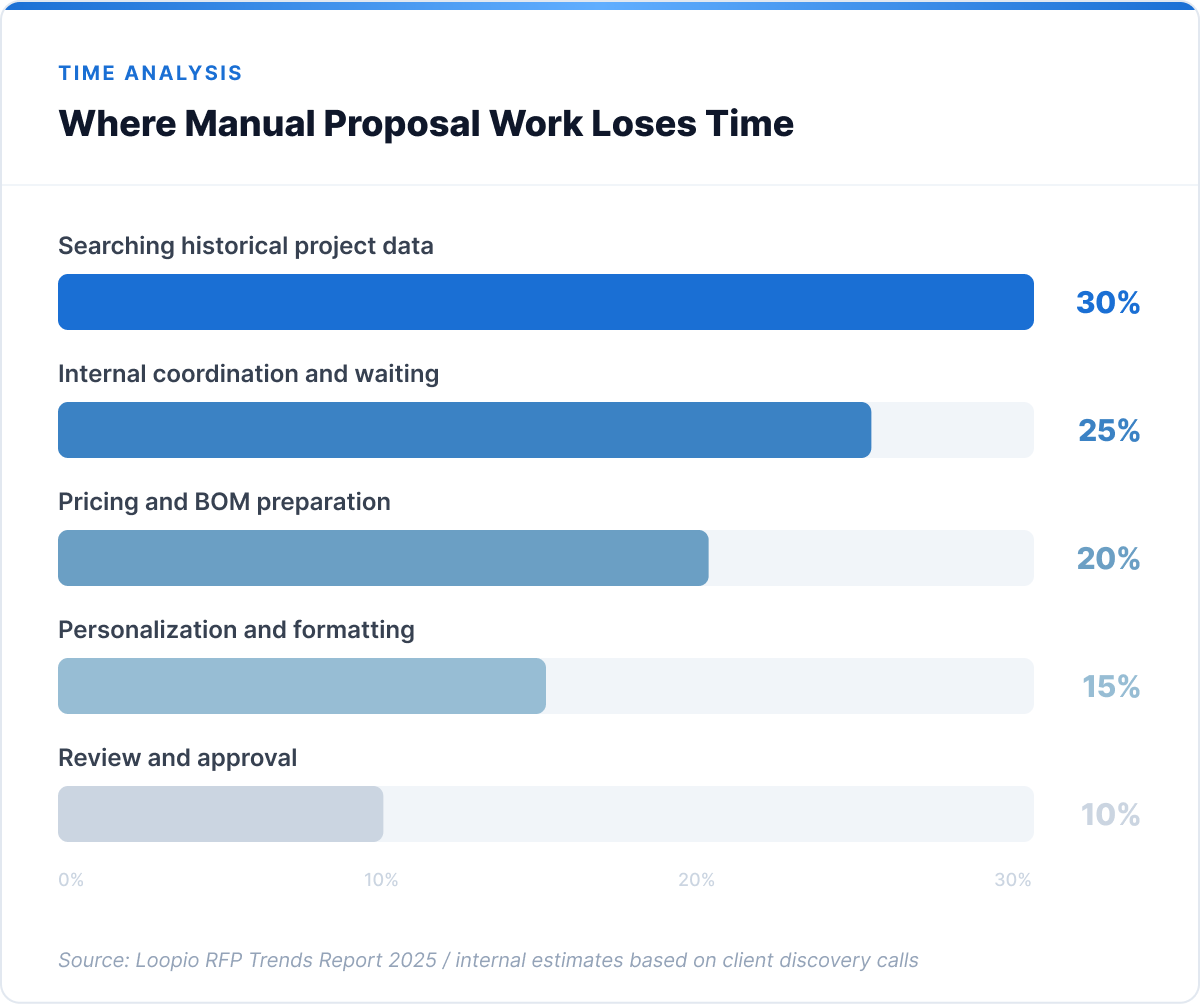
Where proposal preparation loses time and money
Before getting to solutions, the problem needs to be measured.
A typical B2B company with an active sales function processes between ten and fifty RFPs per month. Each one requires assembling data from multiple places: historical projects, pricing sheets, technical specifications, subcontractor quotes, CRM records.
With a manual process, this assembly phase takes anywhere from several hours to several days per proposal. According to the Loopio 2025 RFP Trends Report, the average time to prepare a single proposal response was 25 hours – and that’s in companies that already had organized processes.
Three places where proposal work loses the most time:
Searching for data from past projects. The sales rep knows the company did a similar project a year ago. They don’t remember where the files are. They spend an hour on SharePoint, ask colleagues, eventually get a folder with half the documentation. The next RFP – same thing from the start.
Internal coordination delays. A technical proposal needs input from the engineering team. The engineering team is busy. The sales rep waits three days for a component estimate. The client is talking to a competitor in the meantime.
Formatting and personalization. The proposal is ready on substance, but it needs to be adapted to the client’s format, relevant project references added, a cover page prepared. Another two to three hours of work.
Every one of these activities is repetitive. Each one draws on data the company already has. And each one is a candidate for automation.
What an AI agent actually does in the proposal process
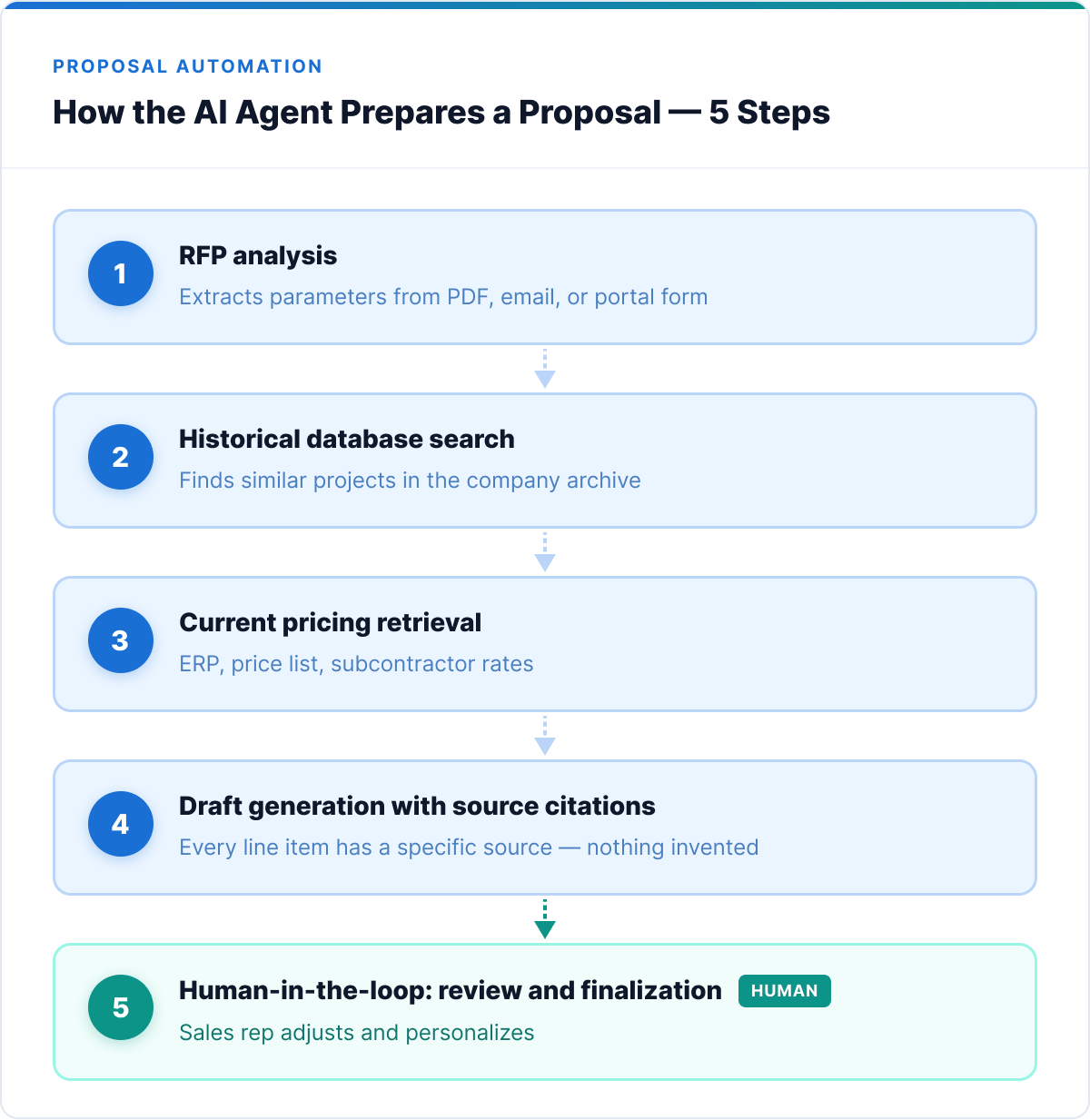
An AI proposal agent isn’t a document template with auto-fill. It’s a system that executes a sequence of actions: it reads the incoming request, searches the company’s own data repositories, generates an initial draft with a source citation for every line item, and hands off to a human for review and finalization.
The critical distinction: the agent works exclusively on the company’s own data. It doesn’t generate numbers from the language model. It doesn’t invent prices or specifications. It retrieves them from historical projects, pricing sheets, cost databases, and ERP systems – and cites the specific source for each item.
In practice, the sequence looks like this:
Step 1: RFP analysis The agent reads the incoming document (PDF, email, portal form) and extracts the key parameters: scope of work, technical specifications, delivery timeline, formal requirements.
Step 2: Historical database search The agent searches the archive of past projects for similar parameters: comparable scope, industry, scale. It pulls cost data and pricing structures from reference projects.
Step 3: Current pricing retrieval The agent queries the ERP system or pricing database for current component prices, labor rates, and subcontractor costs.
Step 4: Draft generation The agent produces a proposal structure with populated line items, source references, and suggested project references. The sales rep receives a working draft to review and adjust – not a finished document to send.
Step 5: Human-in-the-loop The person reviews, corrects, tailors the argument to the specific client context, and approves. Time for this phase: one to two hours instead of two to three days of data gathering.
ROI calculation: what manual proposal preparation actually costs
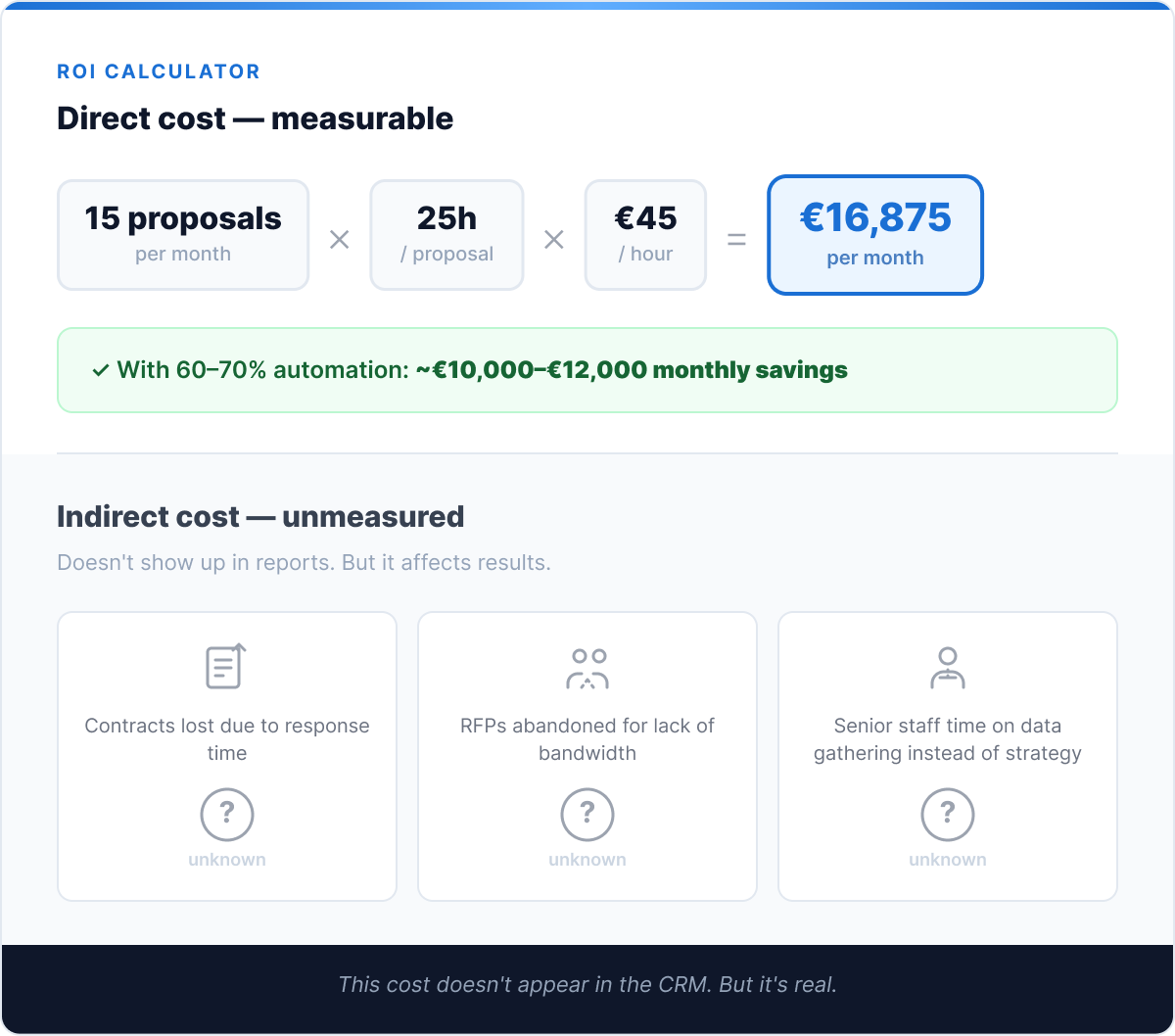
The cost is rarely calculated directly. Here it is.
Assumptions for a company with 5 people involved in proposal work:
- Average time per proposal: 25 hours (Loopio RFP Trends 2025)
- Monthly RFP volume: 15
- Average fully-loaded hourly cost (sales rep + technical support): €45
Monthly manual cost: 15 proposals × 25h × €45 = €16,875 per month
Annually: ~€202,500 in labor time spent purely on proposal preparation.
This isn’t a cost that can be fully recovered – the review, personalization, and approval phases will always remain with a human. But if automation takes over the data gathering and draft generation phases (approximately 60–70% of total time), the potential savings are:
~€121,500–€141,750 per year for a team handling 15 proposals per month.
But the direct cost is only half the equation. A slow proposal process also generates an indirect cost: contracts that go to competitors because the response arrived too late. That cost doesn’t show up in any report. And because it’s invisible, nobody fixes it.
When AI proposal automation makes sense – and when it doesn’t
An honest answer requires naming the limits.
Automation delivers the highest ROI when:
- The company processes at least 8–10 RFPs per month with a repeatable structure
- Cost data and historical projects are accessible in a system – not locked in specific people’s heads
- Proposals draw heavily on repeatable components, rates, or scopes of work
- ERP or pricing system integration is technically feasible
When to wait, or start with data cleanup first:
- Every proposal is completely unique and requires a specification built entirely from scratch – the automation scope will be minimal
- Historical project data and cost data aren’t structured or centrally accessible – the agent has nothing to work from
- Volume is below 5–8 proposals per month – the implementation payback threshold is hard to reach at low volume
Transparency here is our standard. If a discovery workshop reveals the data isn’t ready, we say so directly and propose where to start instead.
Case study: B2B manufacturing company – from weeks to one day
One of our partners is a B2B manufacturing company handling several dozen RFPs per month, each requiring pricing based on technical documentation and current component costs. Each proposal involved three to four people and took three to ten working days to prepare.
The problem: proposal data was scattered – pricing in Excel, historical projects on SharePoint with inconsistent folder structures, key knowledge held by specific senior engineers. With growing inquiry volume, the team regularly worked overtime. Some RFPs were abandoned because there wasn’t capacity to respond.
The solution: An AI agent integrated with the historical project database, pricing catalog, and ERP system. Before the agent went live: three weeks of data cleanup and indexing. Then a four-week PoC on a selected proposal type.
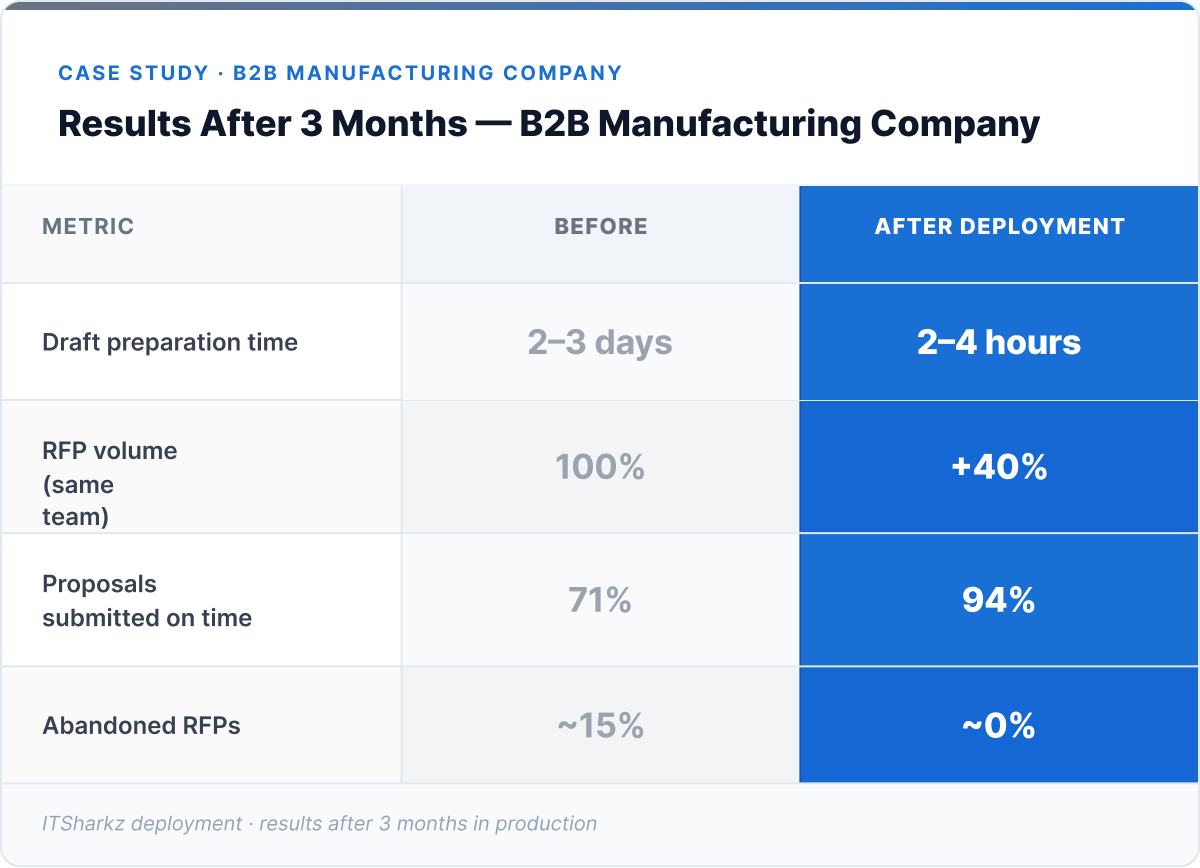
Results after three months in production:
- Draft preparation time: from 2–3 days to 2–4 hours
- RFP volume handled: up 40% with the same team
- Proposals submitted on time: from 71% to 94%
- Abandoned RFPs: from ~15% to near zero
The value of this deployment doesn’t lie solely in time savings. It lies in the ability to participate in more tenders without additional headcount.
→ See how ITSharkz builds AI agents for proposal and sales processes
How to start: a 6-week implementation model
The most common mistake when automating proposal preparation: trying to automate the entire process at once. The right approach is a narrow PoC on one proposal type, with well-prepared data as the foundation.
Week 1–2: Discovery and data audit Mapping the current proposal process, identifying RFP types and volume, assessing the availability and quality of historical data. This phase often reveals that two to three weeks of data cleanup are needed before the agent can be configured.
Week 3–4: Configuration and integrations Indexing the historical project base, integrating with the pricing catalog or ERP, configuring business rules (what the agent suggests, which items require human validation).
Week 5–6: PoC on the selected proposal type The agent runs on real incoming RFPs in “suggest only” mode – generating drafts while the team evaluates quality and calibrates rules. At the end of the PoC: a performance report as the basis for a go/no-go decision on full deployment.
Total timeline from workshop to production: 8–12 weeks for one proposal type with available data.
For the full methodology – from selecting the right pilot use case to pricing models – read our guide to implementing AI automation in your company.
Summary
AI proposal automation is one of the few areas where the ROI of an AI agent deployment is fast and clearly measurable – because proposal preparation time can be counted before and after, and the effect shows up within weeks.
Three things to remember:
- The problem is in the data, not the technology. An AI agent is only as good as the historical project base and pricing data it has access to. Cleaning up data before the deployment isn’t an extra cost – it’s the precondition for the system to work.
- Automation covers 60–70% of total time. The data gathering, historical search, and draft generation phases. Review, personalization, and the final decision stay with the human – and that’s exactly right.
- 68% of the competition is already in the process. Every month without automation is a month someone else is building the proposal history and data foundation that makes their agent more effective over time.
How many RFPs does your team handle per month? One workshop conversation is enough to know how much of that can be accelerated.