

Most companies find out if a hire was a mistake six months into the engagement. By then, reversing the damage is slow, expensive, and politically awkward.
We built a vetting process designed to solve this before you meet a single candidate. What follows is not a capabilities deck – it’s the concrete detail of what we actually do, and why it produces fundamentally different outcomes.
What You Are Really Afraid Of
The companies that come to us aren’t worried that Polish developers are less capable. They’re worried about what they can’t verify from a distance.
Here’s what we hear, without the diplomatic softening:
“My entire team codes and reviews in French. I can’t afford English-only profiles.”
“We had eight developers leave in a single semester. I can’t go through that again.”
“Our previous CTO was the only one who understood the codebase. When he left, we lost everything.”
“I need people with genuine production depth – not profiles who treat this like a homework assignment.”
These aren’t irrational fears. They’re patterns that happen when vetting processes are designed to close deals quickly rather than to protect teams long-term.
According to 2026 data from Talmatic, European companies spend an average of 5.4 months recruiting for senior technical positions. SHRM’s 2025 benchmarks indicate that an unfilled senior engineering role can cost a scaling company between one and three times the annual salary in lost output over a single quarter. The real risk isn’t hiring too slowly – it’s hiring the wrong person, fast.
The Ratio That Explains Everything: 20 → 2
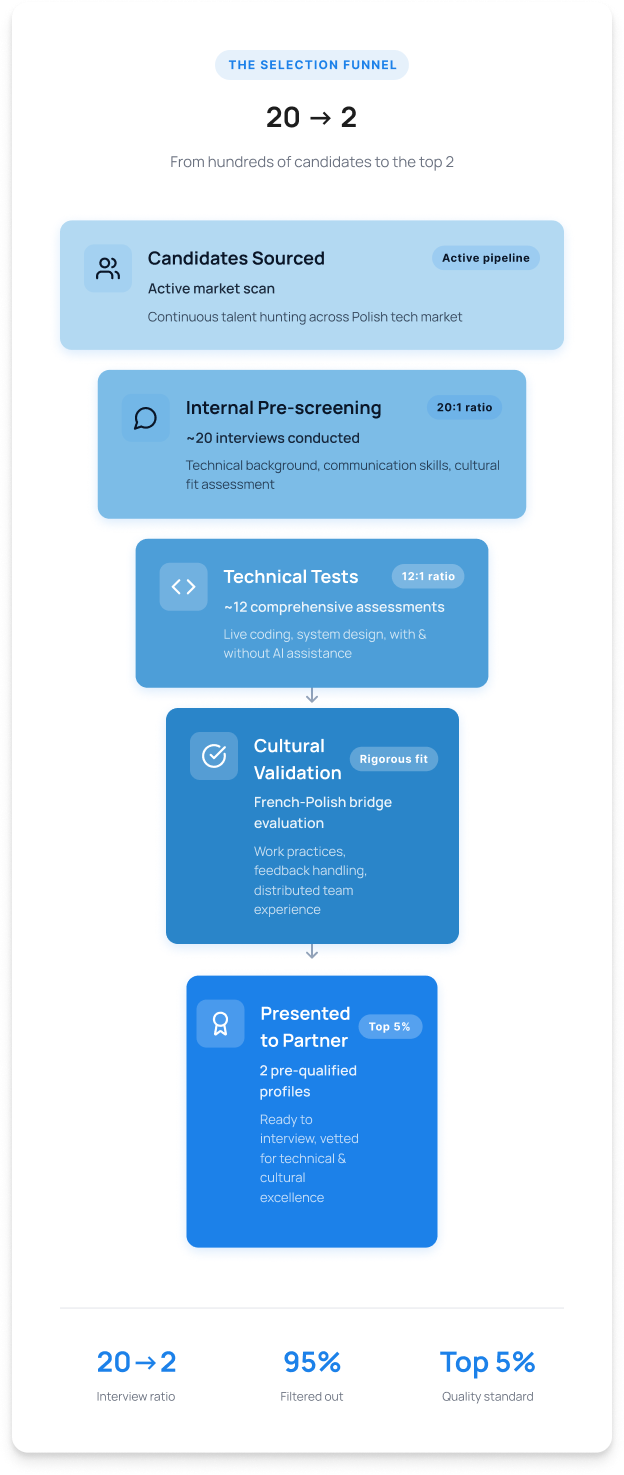
Before presenting a single candidate to a partner, we conduct approximately 20 internal interviews and run around 12 technical tests. What you receive: 2 pre-qualified profiles.
This ratio is a design constraint, not a positioning claim.
We protect your time. A CTO or Tech Lead shouldn’t spend 15 hours interviewing candidates to find one acceptable hire. Our job is to do that filtering upstream, with a rigour that most internal teams neither have time nor tooling to apply consistently.
The selectivity has a meaningful side effect: the profiles we present are already rare before they reach you. In France, recruiting a senior developer costs an average of €12,000 internally and up to €25,000 through a specialist agency, with timelines regularly stretching to 3–6 months for senior roles with notice periods. Our process compresses that timeline without compressing the standard.
Step 1: Define the Profile Before Searching
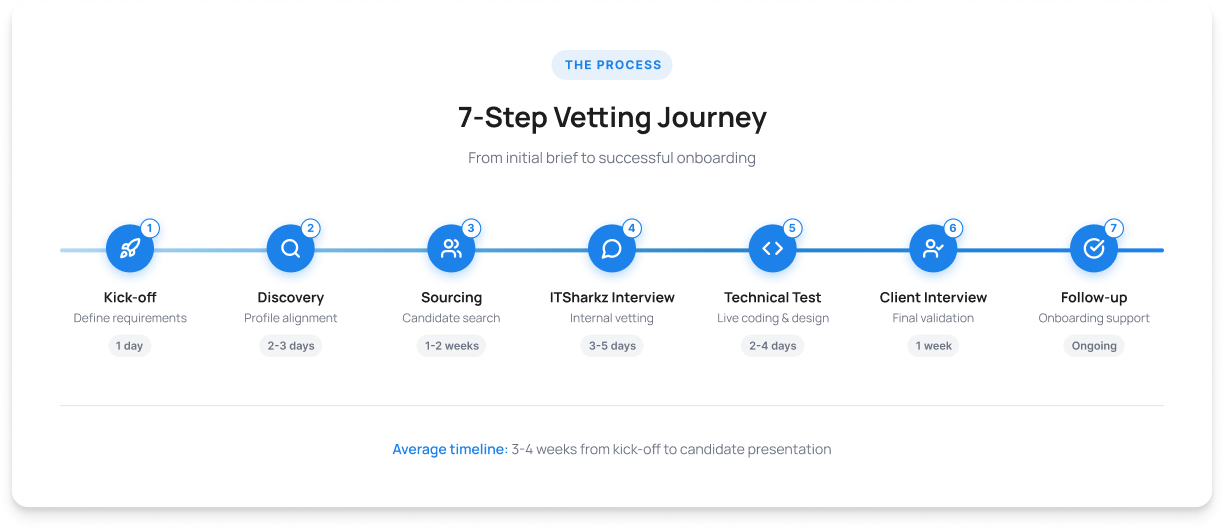
We don’t start by searching a database. We start by spending time with your tech leads and cultural stakeholders to define the right profile – technically and humanly. The search only begins once that profile is locked.
This is the step most traditional recruitment agencies skip. It’s also the primary cause of failed placements: a technically capable person who simply doesn’t fit the team.
What we define together upfront:
- Stack, product context, architecture constraints
- AI usage rules – yes, no, and how
- Must-have vs. nice-to-have technical criteria
- Non-negotiable communication and cultural criteria, including working language
- The client’s interview process
Clarity upfront produces better matches on the first attempt. Less exciting than a speed promise, but it’s what determines whether the placement holds over time.
Step 2: Technical Validation – With and Without AI
Our internal validation process covers four dimensions that generalist agencies almost never evaluate together.
Engineering level – with and without AI assistance. We test both. A profile that produces good code exclusively with Copilot is not a senior profile. We want engineers who understand what they produce, who know when to trust AI and when to override it.
Communication and ownership. A developer can master every design pattern. If they can’t explain a technical decision to a product manager, raise an alarm when something is wrong, or take ownership of a scope without constant supervision – it’s not the right profile for a scale-up.
Cultural fit. This isn’t about personality. It’s about practices: how does this profile work in a distributed team? How do they handle direct feedback? How do they adapt to a mid-sprint priority change?
AI mindset – not blind copy-paste. Our AI-ready checklist is non-negotiable:
- Copilot usage for refactoring, debugging, documentation
- Tests-first (unit, integration, CI) as reflex, not imposed constraint
- Security and privacy reflexes – knowing what should not go into a public model
- Generate → review → test → document as a daily practice loop
Step 3: Cultural Fit as a Formal Criterion
ITSharkz sits at the intersection of French business culture and Central European engineering rigour. This isn’t a marketing angle – it’s our operational reality since 2018.
Our founders navigate both cultures natively. This means we’re not looking for Polish developers who are “good enough” to work with French or Western European companies. We’re looking for profiles who already have fluency in that register – in direct communication, feedback handling, delivery standards, and sometimes language itself.
On language: French-speaking profiles exist in our pipeline and are sourced specifically when it’s non-negotiable for a partner. This isn’t a workaround – it’s a standard offering. For companies where code reviews, daily standups, and documentation happen in French, we can source profiles at that level. Technical staff primarily work in English; French-speaking profiles exist at senior and project management levels.
On physical proximity: Poland is a 90-minute flight from Paris, Lyon, or Bordeaux. We regularly organise on-site onboarding weeks at partner offices in France. For companies nervous about full remote from day one, this is concrete reassurance – not theoretical.
According to the European tech job market data from Index.dev, 57% of EU firms report they simply cannot find qualified tech staff. The talent isn’t gone – it’s in markets where access requires structural knowledge, not just a LinkedIn subscription.
→ About ITSharkz and our history
Step 4: Two Sourcing Paths, One Quality Standard
Our pipeline operates in two modes depending on the situation.
Profile available in active projects. When a matching profile exists in our active base, it can be deployed immediately – without compromising standards. Our dedicated recruiters are actively searching the Polish market at all times, even between mandates. When you call, we’re not starting from zero.
Full market search. When the exact profile doesn’t exist in our active pipeline, we launch a market search with the full pre-screening process applied. Same ratio. Same rigour. Same quality guarantee.
The difference between the two modes is timeline. Quality level doesn’t vary.
What Partners Validate After Hiring
These examples come from real collaborations – names are known, results are documented in our case studies.
Qobuz – European leader in hi-fi music streaming – has worked with ITSharkz for 3–4 years. The relationship started with software developers and expanded into data and AI work. The expansion happened because the initial hire performed. Not because we sold it.
Weezevent – a high-volume ticketing platform – embedded the ITSharkz team into their full IT operation, including MLOps work and peak-load detection. Trust was earned through consistent technical delivery.
A retail innovation project (connected shelf hardware, in-store retargeting) went from POC to production in 6 months with ITSharkz developers embedded alongside the internal team.
A scale-up project that “should have taken 2–3 years” was delivered in 1 year when ITSharkz provided 4–5 senior developers alongside the partner’s junior team and CTO.
A blockchain infrastructure project involved ITSharkz contributing to the smart contract layer of a major open protocol – the kind of reference that signals genuine seniority, not commodity development.
Continuity as a Commitment, Not a Promise
Two points that structurally distinguish our model from standard agencies.
Dedicated, not rotating teams. The same developers stay on the project long-term. This isn’t a commercial formula – it’s a model constraint. We don’t reallocate juniors based on internal margin calculations. Knowledge of your system stays in the team.
After the build, the same developer stays. Once a build phase is complete, the developer who built your system remains available for maintenance – part-time if needed. You’re not handed off to an anonymous support pool. This changes the long-term risk calculation materially.
Post-onboarding: structured follow-ups at 30, 60, and 90 days to verify delivery health on both sides.
What This Process Prevents, Concretely
Black-box dependency. The nightmare scenario: one external developer is the only person who understands the codebase. They leave. You lose everything. Our validation process explicitly tests a profile’s ability to document, transfer knowledge, and write code that others can read and maintain.
Knowledge turnover. Several of our partners had been burned by entire teams departing. Our near-zero rotation isn’t a claim – it’s the result of a recruitment process that selects for profiles motivated by the project long-term, not the next opportunity.
Technically strong, humanly incompatible. Formal cultural validation prevents the classic failure mode: a brilliant developer who doesn’t communicate, doesn’t raise alarms, and ends up creating more friction than value inside the team.
The Question to Ask Any Recruitment Partner
Before signing with anyone to integrate external profiles into your team, ask this: “How many candidates do you screen before presenting one to us?”
If the answer is vague – if you hear “large talent pool,” “algorithmic matching,” or “database of X,000 developers” – you have your answer.
The right answer looks like a precise ratio, a defined process, and selection criteria that go beyond CV and code test.
→ Read about digital sovereignty and de-risking
Building a technical team for the next 3 years? Let’s talk about what you actually need to find – not the generic profile, but the right one.→ Book a 30-minute conversation with our team