Itsharkz

Where AI Belongs (and Doesn’t) in a Custom Software Build

Most engineering write-ups about adding AI to a product lead with the AI. This one leads with where we chose not to put it.

A partner came to us with a familiar kind of problem: a business-critical process still running almost entirely on spreadsheets. Data arrived daily from a wide network of external partners, each using its own format, with no shared structure and no shared visibility into where anything stood. The bottleneck wasn’t the underlying work. It was coordinating it by hand.

That’s the kind of problem our dedicated IT solutions team builds custom software around: replace the manual process with a platform that imports the incoming data, routes it to the right internal specialists, tracks status end to end, and gives everyone a single, current view of what’s happening.

The stack was set by the partner, and that was fine. Angular on the frontend, NestJS on the backend, Microsoft SQL Server for the database, all matched to what their own small internal technical team already knew and would maintain going forward. Our developers would have defaulted to different choices. It didn’t matter. The team that owns this after we’re gone gets a say in what it’s built with, and that’s a straightforward trade-off: our short-term preference against their long-term ownership.

The interesting problem wasn’t technical, it was structural. Every external partner exported its data differently. Different column names, different layouts, different conventions for the same underlying information. Before any internal specialist could act on a case, someone had to manually reshape that file into something consistent. That reformatting step was mostly operational overhead: not the substantive judgment the specialists were there to make, but tedious, error-prone work standing between the data arriving and the real work starting.
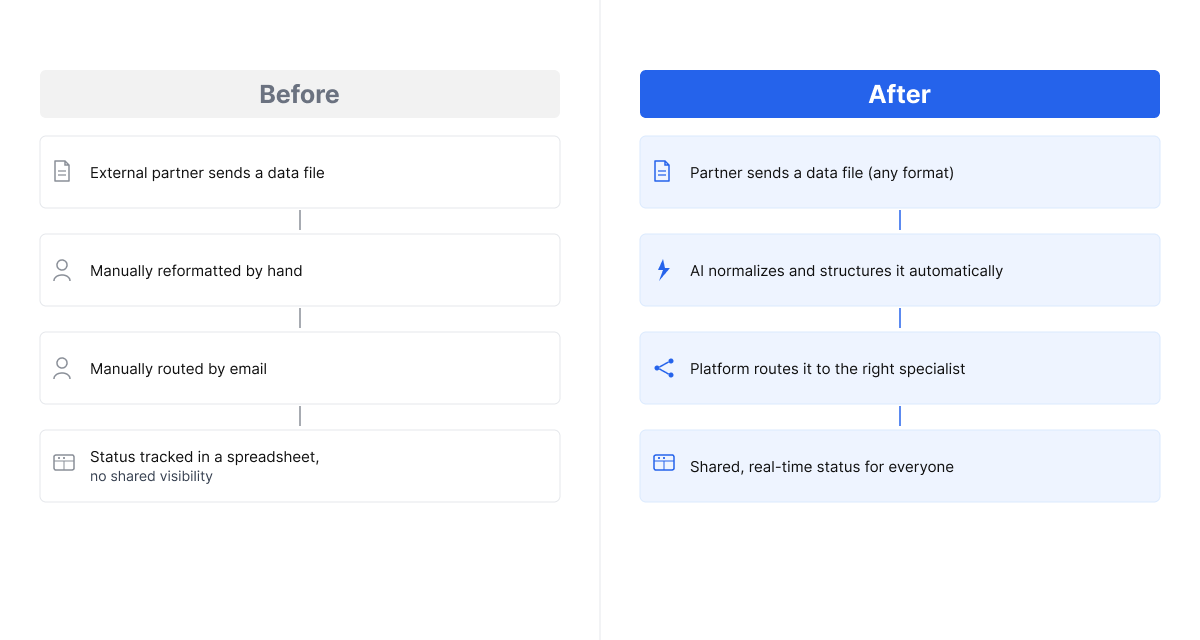
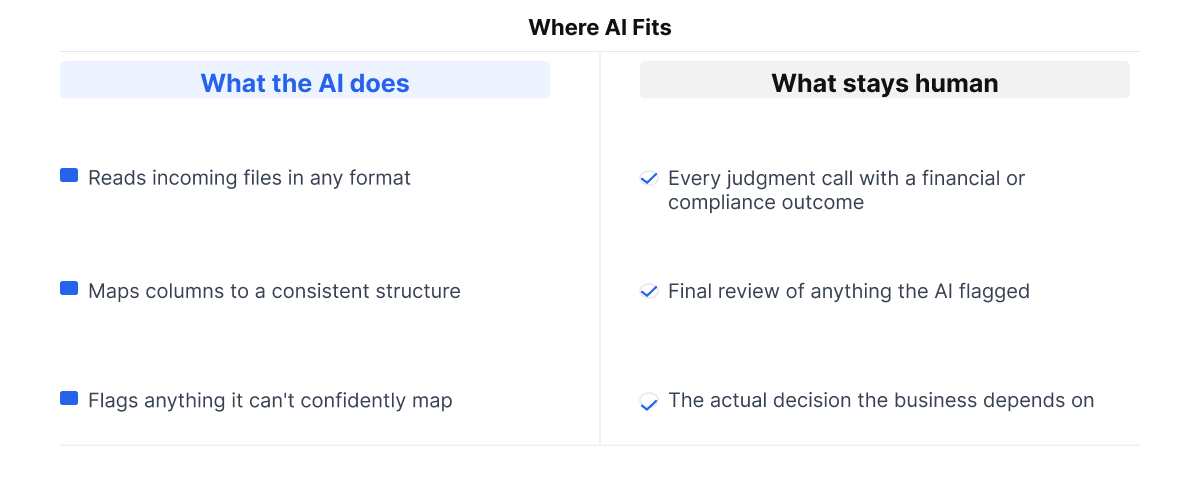
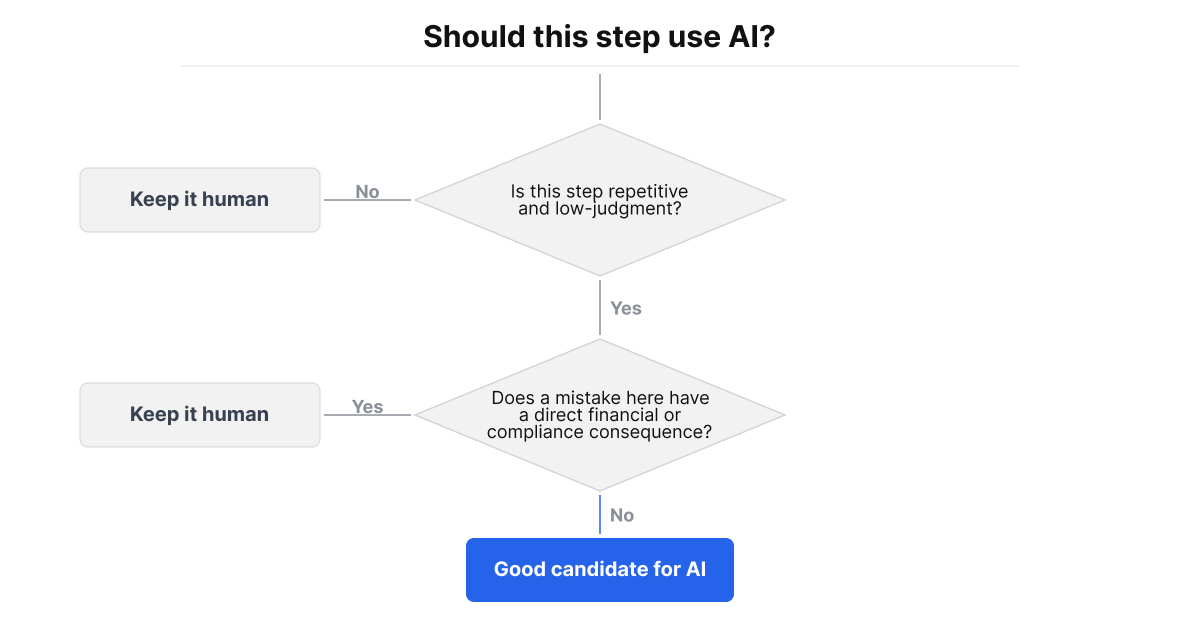
That’s the one place we used AI. It sits at the import step and maps incoming files to a consistent internal structure, even when source spreadsheets use different layouts, column names, or conventions. Ambiguous mappings are flagged for human review instead of being accepted silently. The scope is deliberately narrow: format normalization, not decision-making. It does not make or approve the judgment calls that follow. Those remain with the partner’s own specialists. In a workflow where a wrong decision can have a direct financial or compliance consequence, AI is useful for preparing structured input, not for replacing accountable human judgment. That boundary is something our AI development work comes back to on almost every regulated or high-stakes build.
The rest of the platform is what you’d expect from a well-built internal tool: a queue for routing work across the team, status tracking people can actually rely on, and built-in messaging tied to each case so questions don’t get lost in an email thread.

Working with a small, lean partner team changes how you deliver. There was no room to wait on detailed specs between check-ins, so we didn’t try to get one. The partner gave us a general, high-level brief and regular demo cycles, and our dedicated team made UX and workflow calls directly, then validated them live at each demo. It’s a model that only works with a partner who trusts the team to make practical product decisions quickly, while keeping a lightweight record of key decisions, demo feedback, and acceptance points. It moved faster than a heavier spec-and-signoff process would have, without losing the traceability needed for handover.
The result is a process that used to run on scattered spreadsheets and now runs on a platform with one clear operational view.
The CTO’s Guide to IT Outsourcing: Why Culture and English are the New Global Standards

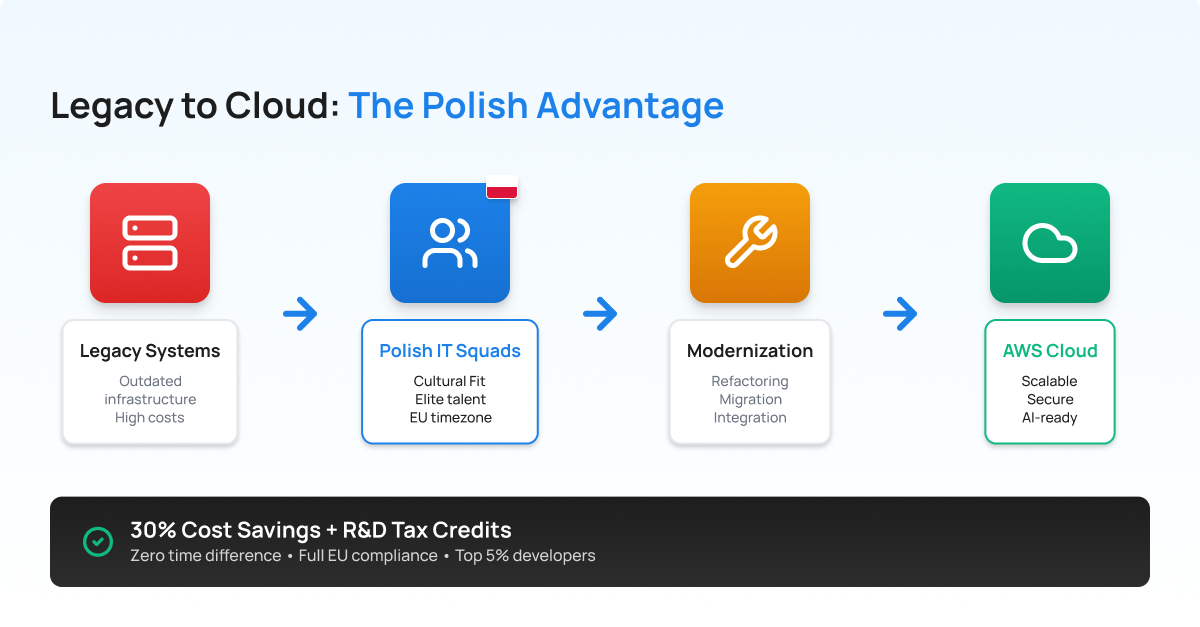
In today’s economic climate, “efficiency” is the word of the year. For tech leaders managing large-scale legacy environments, the pressure is double: modernize the infrastructure (AWS migration, AI implementation) while adhering to strict “cost-killing” mandates from the board.

Strategic IT outsourcing is the escape hatch. But to do it right, you have to look beyond the traditional “vendor” model.

1. Why English-First Teams Outperform Local Language Providers

There is a common misconception that remote teams must speak the local language to be effective. In reality, for high-level engineering, English is a filter for quality.

By hiring dedicated, English-speaking Polish squads, you ensure that your documentation, code reviews, and architectural discussions are aligned with global best practices. This eliminates the “translation tax” – the subtle loss of technical nuance that happens when teams try to force-fit complex AWS or Kubernetes concepts into a local dialect.

2. Solving the “Trust Gap” with Cultural Alignment

The biggest risk in outsourcing isn’t the distance; it’s the disconnect. If a developer doesn’t understand your company’s “Why,” they will deliver a product that meets the ticket requirements but fails the business.

Our approach at ITSharkz focuses on “Product Ownership.” We match engineers based on their cultural fit with your team. Do you move fast and break things? Or are you in a highly regulated industry requiring extreme precision? We provide a dedicated extension that shares your DNA, using English as the bridge to global excellence.

3. The Financial Strategic Play: Buying Speed, Not Just Hours

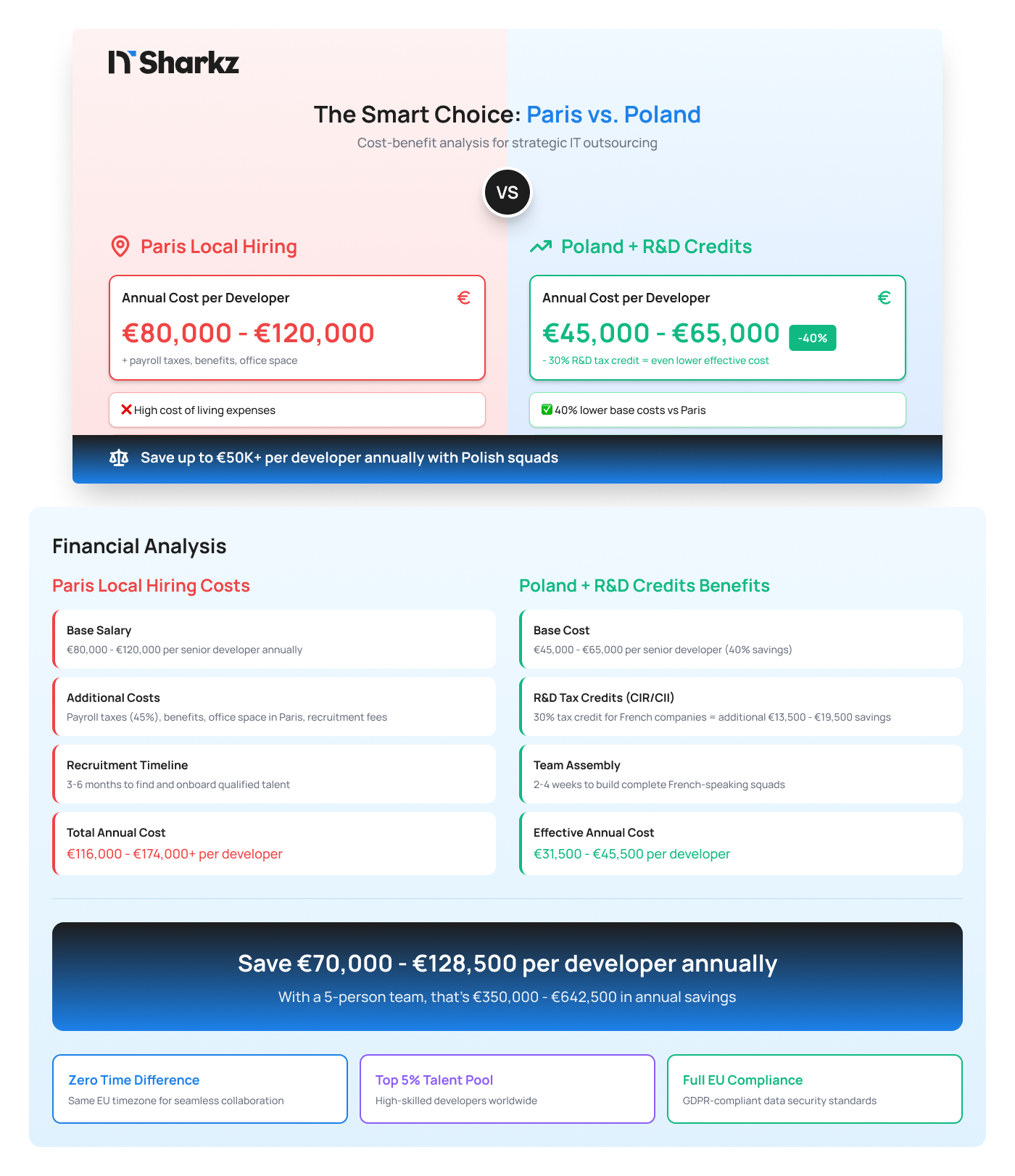
When the CFO demands budget cuts, they are actually demanding better ROI. Strategic outsourcing in Poland provides a unique financial trifecta:

  • High-Velocity Engineering: Polish developers are consistently ranked among the best globally for technical problem-solving.
  • Operational Agility: Scale your team up or down without the friction of local labor laws.
  • Tax Optimization (CIR/CII): For French-based scale-ups and enterprises, our R&D model allows you to leverage significant tax credits, effectively subsidizing your innovation roadmap.

Summary: Building the Hybrid Engineering Hub

The future of IT isn’t local; it’s integrated. By combining elite Polish talent with a culture-first integration strategy, you can finally clear your legacy backlog and start building the AI-driven features your customers are demanding.

The €5bn Race: How to Deploy Scale-up Europe Capital Without the Hiring Bottleneck

Spring 2026 is coming.

For many founders and innovators across the continent, the release of the “Scale-up Europe” funds represents a massive injection of fuel. But while finance teams are celebrating the incoming capital, CTOs are looking at the calendar with dread.

Here is the reality no one puts in the pitch deck: Money transfers instantly. Engineering teams do not.

If your strategy relies on hiring senior talent in London, Paris, or Berlin after the funds hit your account, you have already lost the first lap.

The Mathematics of Stagnation

Let’s look at the timeline for a standard local hire in Western Europe:

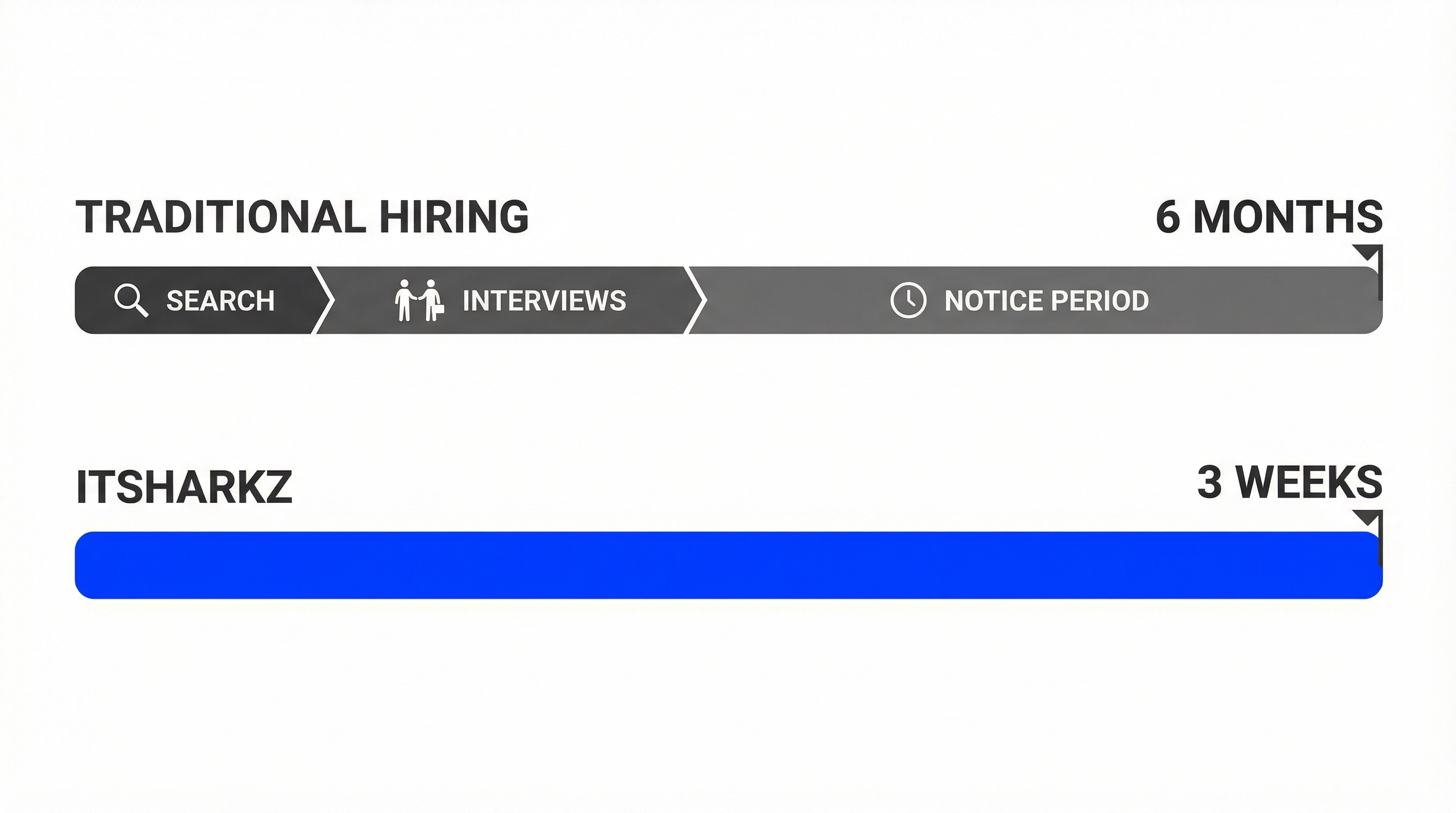
  • Search & Vetting: 1–2 months.
  • Offer Negotiation: 2 weeks.
  • Notice Period: 3 months (standard in France/Germany).
  • Onboarding: 1 month.

Total time to first commit: ~6 months.

If your funding lands in May, your new product features won’t see a line of code until November. In a hyper-competitive market, a six-month lag isn’t just an inconvenience; it is an existential threat.

The Polish Strategic Advantage

While your competitors fight over a shrinking pool of local engineers, smart scale-ups are looking East. Poland isn’t just a neighbor; it is the engine room of European tech.

By partnering with ITSharkz, you bypass the friction of recruitment entirely. We don’t hand you a stack of CVs to sift through. We deploy complete, cohesive units.

  • Speed: We deploy senior teams in 2–4 weeks.
  • Retention: We maintain 2% rotation on our core teams. You don’t lose institutional knowledge.
  • Quality: Polish engineers are ranked #3 globally (HackerRank). They don’t just code; they solve business problems.

Keeping the Capital in Europe (Compliant & Secure)

Investors, especially institutional ones backing the Scale-up Europe initiative, care deeply about data sovereignty.

Venturing outside the EU for development introduces GDPR nightmares and IP risks.

ITSharkz operates strictly within the EU legal framework. Your data stays protected. Your IP remains yours. And for our French partners, working with us aligns seamlessly with R&D tax incentives (CIR/CII), keeping your burn rate efficient.

How to Win the Race

The companies that win in 2026 won’t be the ones with the most cash. They will be the ones with the fastest Time-to-Code.

Don’t let your roadmap gather dust while you wait for notice periods to end.

Ready to secure your technical team before the funds hit the account?